

Quick Answer: Is a workout plus a brain-training exercise better than either one alone for someone with mild cognitive impairment? A trial involving 146 older adults found some promising differences on MRI scans after a combined program. But the effect was limited to particular comparisons and measurements. Researchers did not show that the program prevents dementia or Alzheimer’s disease.
Cycling and solving a quick visual puzzle work very different parts of your day. So what happens when people practice both regularly? Researchers explored that question in older adults who were already noticing measurable memory difficulties. Rather than checking whether anyone had avoided dementia, they looked for changes on brain scans over time.
A secondary analysis of a randomized trial published November 18, 2026 in JAMA Network Open examined MRI markers rather than relying on headlines about ‘reversing brain aging.’ Its results are more specific—and more interesting—than a general claim that exercise fixes memory problems.
Who participated in the exercise for mild cognitive impairment study?
Researchers enrolled 146 adults with amnestic mild cognitive impairment, a condition involving measurable memory difficulties that do not yet amount to dementia. Participants were, on average, 73.8 years old; 75 were men and 71 were women. They were assigned to four groups for a six-month intervention.
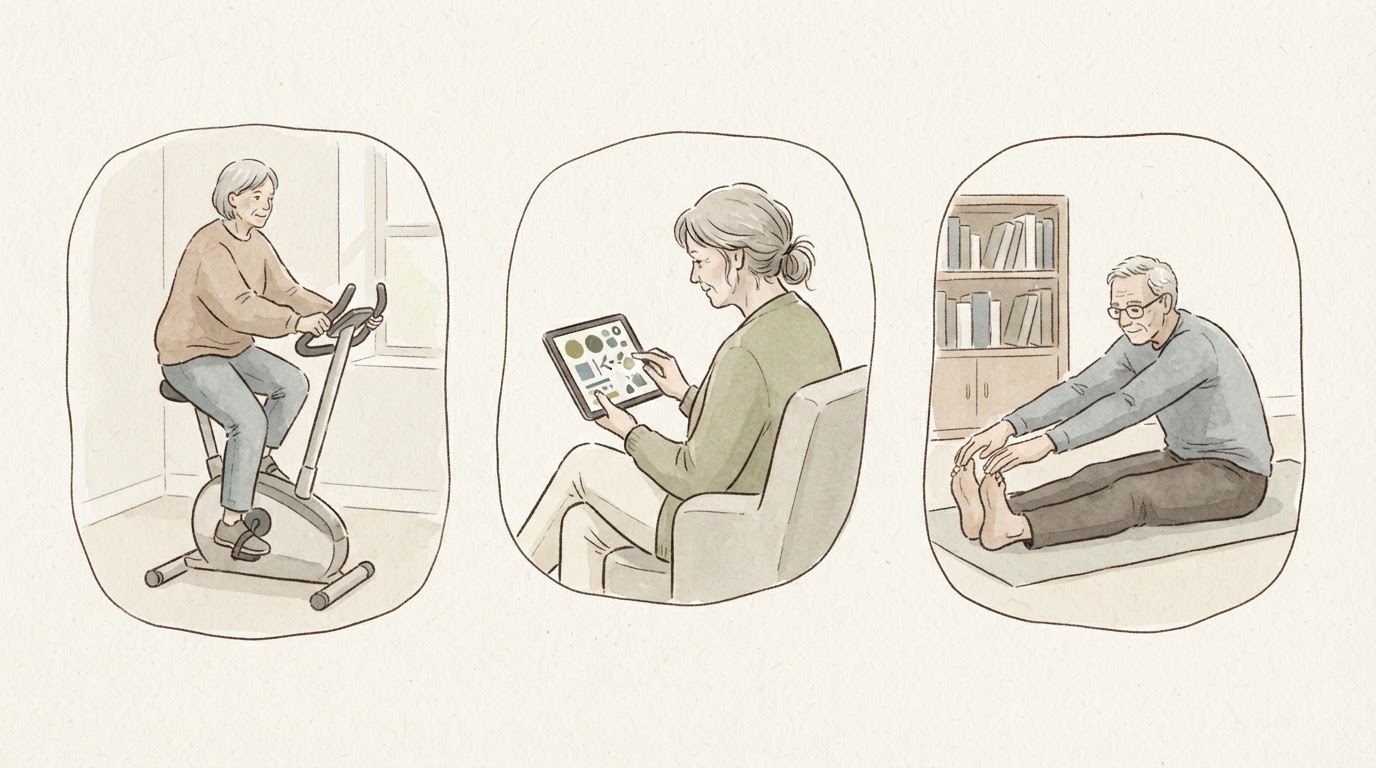
One group combined stationary cycling with speed-of-processing training, which uses structured cognitive exercises. A second group performed cycling alone. A third completed speed-of-processing training alone, while a fourth participated in stretching plus mental leisure activities. Brain scans were collected at baseline, after the six-month intervention, and again at 12 and 18 months.
Importantly, this is not the same trial as the larger U.S. POINTER study widely reported in November. The new paper was a secondary brain-imaging analysis of a separate, smaller trial. Its participants all had an existing diagnosis of amnestic mild cognitive impairment.
What the MRI results actually showed
The researchers focused on two markers. The first was cortical thickness across regions often affected early in Alzheimer’s disease, sometimes called Alzheimer disease signature cortical thickness. The second was white matter hyperintensity volume, a measure of areas that appear bright on certain MRI scans and may reflect several forms of vascular or other tissue change.
Compared with the combined cycling-and-cognitive-training group, participants assigned to speed-of-processing training alone showed more decline in the cortical-thickness measure at the 18-month follow-up. Those in the stretching-and-mental-leisure group showed more decline at 12 months. Both were statistically significant in the main analysis after the researchers accounted for missing measurements.
There was no statistically significant primary difference between combined training and cycling alone for that cortical-thickness outcome. Nor were the main comparisons for white matter hyperintensities significant. An exploratory analysis among participants with complete scans suggested a difference between cycling and combined training for white matter changes at 18 months, but the authors advised caution about such subgroup findings.
A different scan doesn’t mean dementia was prevented
The study tracked changes in tissue-related MRI measurements, not the number of people who went on to develop dementia. Cortical thickness can offer information about structural aging, but a small group difference measured in fractions of a millimeter does not establish an individual clinical benefit. Memory and cognitive test outcomes from the broader trial were reported separately.
The analysis also faced fewer complete scans at later follow-ups. Although the authors used statistical methods to address missing data, estimates can be sensitive to assumptions and to which participants remain in a study. Analyses involving session attendance were exploratory because attendance was not randomly assigned after the original group allocation.
What should a reader make of this?
Physical activity and mentally engaging activities may both be worthwhile parts of a healthy routine, but a person with suspected mild cognitive impairment needs an assessment of the cause and an individualized plan. The findings do not identify a universally effective cycling dose or a specific brain-training game that prevents progression to Alzheimer’s disease.
This work also addresses a different biological question from our report on the glymphatic system and sleep, which examined fluid rhythms rather than cortical-thickness responses to training. Neither study supports a product advertised as a ‘brain reset.’
The next step is a larger, confirmatory trial that tests whether measured structural changes correspond to outcomes people actually notice, such as sustained independence, meaningful memory improvement, or reduced progression to dementia. Until then, any decision about starting exercise or cognitive training should reflect a person’s physical ability, medical history, interests, and access to supervision.
Healthy Routine Lab take: A few MRI findings favored the combined program, but cycling alone wasn’t clearly worse on the main cortical-thickness comparison. That’s a reason to keep researching, not a reason to promise that brain training will stop dementia.
Sources
Original full-text study, methods and results.
Educational information only. This is not medical advice or a recommendation to replace cognitive assessment or treatment.
See also: Wearable Health Devices: What Your Watch Can and Can’t Tell You