

Quick Answer: In a study of 67 older adults, daily routine and sleep difficulties were not the same thing. People with insomnia reported more pain and depressive symptoms than good sleepers, yet their daily schedules were not significantly less regular. Across the sample, more consistent timing of everyday activities was associated with fewer symptoms. The research did not test whether changing a routine improves pain, depression, or insomnia.
A regular bedtime is often discussed as though it guarantees restorative sleep. The data behind this study complicate that assumption. A person may keep predictable daily activities and still experience insomnia. Another may sleep well while their meals or social activities occur at varying times.
The research was first published online in March 2026 in the Journal of Behavioral Medicine and described by the University of Missouri in July. A November news report brought it back into circulation. The useful question is not whether a routine is a newly discovered cure, but what the researchers actually measured.
Why daily routine and sleep were different in this study
Researchers examined self-reported information from 67 older adults, whose average age was 68.3 years. Thirty-seven participants had insomnia and 30 were classified as good sleepers. They reported their behavioral-social rhythms—the regularity of activities such as sleeping, eating, and social interaction—along with pain, depressive symptoms, and body mass index (BMI).
The insomnia group reported more pain and more depressive symptoms. However, the study found no statistically clear difference in daily activity regularity between the insomnia and good-sleeper groups. Their BMI also did not differ significantly. This matters because it separates a problem with sleep from the timing of life around sleep.
The association with pain and mood is not a treatment effect
When the researchers analyzed the participants together, more regular behavioral-social rhythms were associated with lower BMI, less reported pain, and fewer depressive symptoms. The relationships were reported regardless of insomnia status. That is a useful observational finding, but it does not tell us what would happen if a participant changed their schedule tomorrow.
The distinction is especially important for the pain result. The comparison between insomnia and good sleepers produced a p-value of 0.049 for pain—just below a commonly used statistical cutoff—while the difference in depressive symptoms was clearer statistically (p < 0.001). Neither number describes how much an individual’s pain or mood would change after adopting a routine. Statistical significance is not a personalized prediction.
What could explain the pattern?
The authors discuss circadian timing as one possibility. Light and darkness help coordinate the body’s approximately 24-hour rhythms, while meals and social activities can also act as time cues. A predictable day might provide more consistent signals. But the study did not directly track changes in internal circadian phase or randomly assign participants to new schedules.
There are other plausible explanations. People living with more pain or lower mood may find it harder to keep appointments and meals at regular times. Work, caregiving, mobility limitations, medications, and other health conditions can influence both activity timing and symptoms. With observational, self-reported information, the study cannot establish which way the relationship runs.
A practical interpretation for everyday life
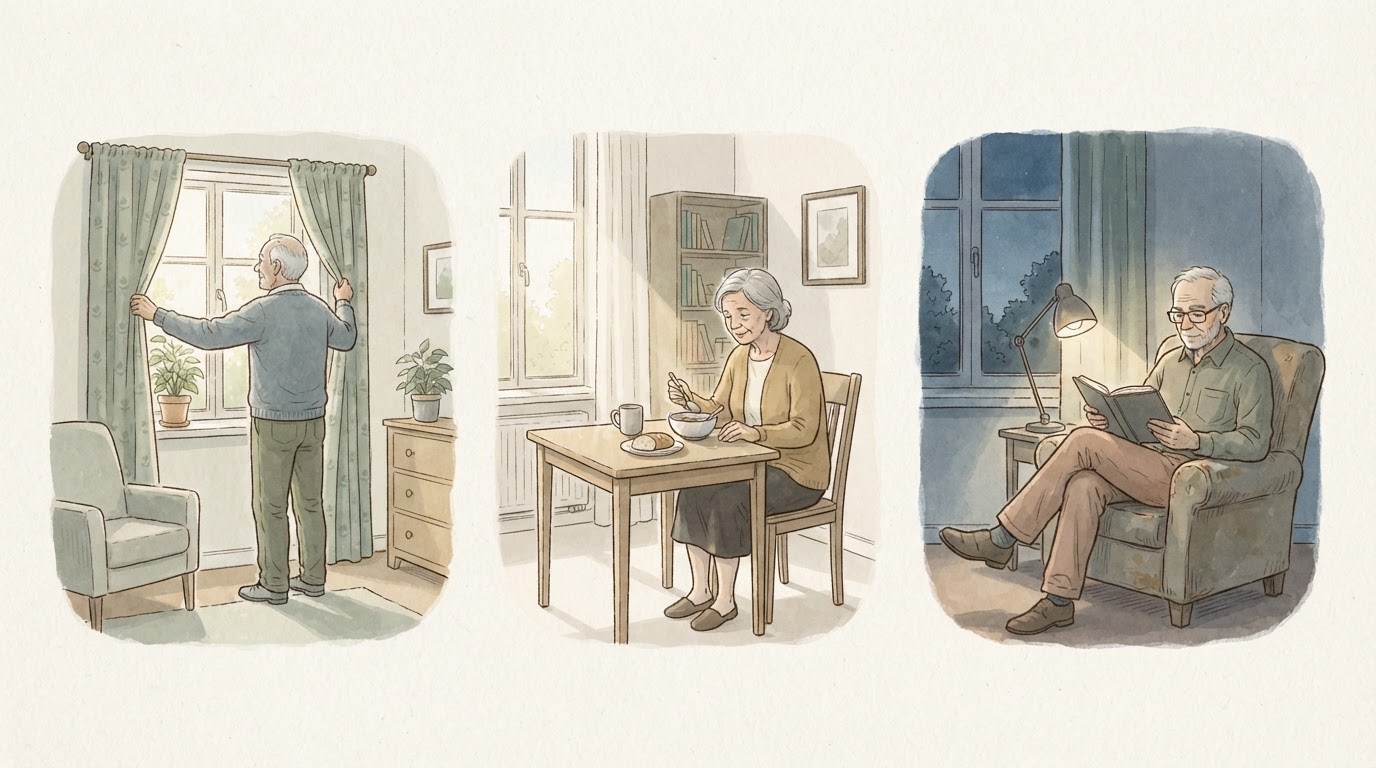
A reader who finds structure helpful might choose one manageable anchor, such as a roughly consistent wake-up time or a familiar morning meal. This is a general way to organize a day, not a pain-relief or depression treatment tested by this study. Rigid schedules may be unrealistic for shift workers, caregivers, and people managing chronic conditions; flexibility can be part of a workable routine.
Sleep health also involves more than time on a clock. Someone with persistent insomnia may need evaluation for contributing conditions, medications, or other causes. If you are also comparing claims about products taken at bedtime, our guide to magnesium before bed addresses a separate question about supplement timing. This observational study tested no supplement.
What a larger study would need to establish
A stronger test would follow participants over time and randomly evaluate an achievable routine intervention against a comparison group. Investigators could track sleep and activity timing with objective measures, assess pain and mood using validated instruments, and report whether any changes are meaningful to patients—not merely detectable in a statistical model.
For now, the most defensible conclusion is narrower than the headlines: regular daily activities and better reported health tended to occur together in a small older-adult sample. The study offers a question worth testing, not evidence that people should replace care for depression, chronic pain, or persistent insomnia with a timetable.
Healthy Routine Lab editorial note: We covered this study because its less-publicized finding—that insomnia and daily routine regularity were not interchangeable—helps readers avoid treating a promising association as a proven intervention.
Sources
Tracy EL et al. Journal of Behavioral Medicine (2026), original peer-reviewed study (DOI: 10.1007/s10865-026-00646-6).
PubMed record for the original study.
University of Missouri news release, July 28, 2026.
For educational purposes only. This article is not medical advice or a substitute for assessment of persistent symptoms.